Indian Point
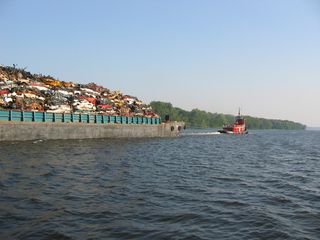
From water level, the towers loomed above me and the entire structure felt imposing. There are layers of red brick buildings smack against the river. Not a window in sight, as if whatever was contained inside shouldn’t be seen, and should not see out. I’d passed some large industry on the river—Trapp Rock up by Poughkeepsie, for instance, but nothing that felt ominous like the Indian Point plant. There are many reasons to protest nuclear power. In my life, the stories of Three Mile Island, Chernobyl and Fukushima are enough to convince anyone this is a risky source of energy. There are many reasons not to want a nuclear power plant so close to a major metropolitan area—9/11 is enough to show how vulnerable we can be. And there are many reasons not to want a nuclear power plant on the Hudson River. The plant rests on a small earthquake fault. And, the plant uses billions of gallons of water t o cool its towers and then spits this warmed water back into the river, altering the ecosystem. In the process, millions of fish are sucked into the plant and killed. But I had not thought about any of this with much care until I stroked past the plant low in my boat.

Solstice Adventures - Tell Me Your Stories

There are many ways to celebrate the solstice. In my mind, having an outdoor adventure is almost required. One year I slipped my kayak into the water before dawn to watch the sun rise while on the river. I paddled north for a few hours, then floated south with the outgoing tide. I was out of the water by noon and had spent eight hours on the river. Already a full day and yet another day’s worth of sunlight stretched before me. This year I intend to do the same: paddle out with the sun.
What I would love is to hear reader’s stories of adventures. Tell me of outdoor adventures you have had or what you intend to do tomorrow. Send your stories as a comment or as an email and I’ll post these to my blog (I am redoing my website; when I am done, there will be a reader’s tales of adventure section).
My Reach
As I slid my kayak into the Hudson River last Wednesday evening, the water grabbed my ankles. My calf muscles seized with the cold. I tuc 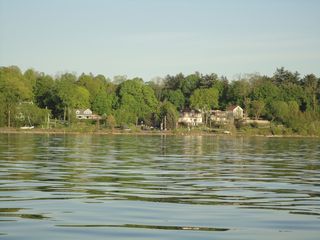
A reach is a stretch of navigable river, often the distance the eye can scan. On the Hudson there are a range of reaches, most with direct names like the Barrytown Reach or the North Germantown Reach. Some have names that have existed since when Henry Hudson sailed up the river in 1609 like the Long Reach off of Poughkeepsie. When Ed Abbey claims the desert in Desert Solitaire as his own, “Abbey Land,” it is because he is the only one there and because he loves it. I too make my claim out of love, but I can’t claim I am the only one on the river. I share my reach with many—many who no doubt imagine that this is their reach as well.
Boat School
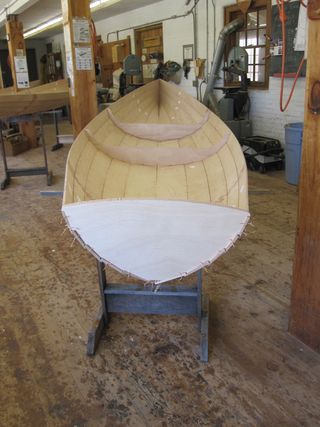
At noon on the second day of boat school, I folded up the
lines of plywood I had stitched together with copper wire. Before me rested
over seventeen feet of something that had the shape of a boat. It would sink, but
it had the feel of water about it. I was not particularly proud of my
accomplishment. All I had done was follow the careful but relaxed directions of
the teacher, a master boat builder named Geoff Kerr. What I had done to arrive
at my boat-like creation was all pretty basic. Drilled a few holes, cut copper
wire, slipped the wire through the holes and twisted them tight. My thumbs were
sore, my back a bit achy from standing and bending over for so many hours; I
had not done anything technically difficult. No wood to cut. No precision to
anything I had done. “Six inches between holes?” I had asked. “About, just eye
ball it.” Whatever might go wrong could be fixed. Nothing that sanding, epoxy
and paint could not fix.