Alice on the River

Alice is my niece, my only niece. She’s twenty years old, a beautiful young woman who loves her friends and family, is completely bilingual (French-English), is first in her law class at King’s College, shops too actively, plays a wicked game of O Hell, and for the past week of vacation had been calling me “la Suse,” and singing “Delta Dawn, what’s that flower you have on?” (go on, listen to it!) inspired from watching reruns of Friends. That moment on the street reminded me how fragile all of this is, and it was with this keen awareness that we made our way toward the river.
It was a sunny day, with a bit of breeze. The tide was going out. The river, a half mile wide at this point, felt enormous. The Catskill Mountains on the far shore looked hazy and far away. I sensed Alice a bit nervous about this adventure. We put the boats in the water, and I straddled hers, steadying it as she slipped in with flexible ease, reminding me she spent years perfecting gymnastic moves. I explained how to hold her paddles, to keep her elbows low, to press her knees against the pads to steady her boat and to help guide it through the water. Most of these moves come naturally to someone in a boat, but a few pointers make for an easier paddle.
My Reach: Unacceptable

My friend John Lipscomb is the captain of R. Ian Fletcher, the Riverkeeper patrol boat. I’ve known him since I was a child as our parents were friends and so I know that water—the rivers and oceans--are in his blood; he’s lived on the Hudson for most of his life. I know few people as passionate about the environmental issues facing the Hudson as John—closing Indian Point, shutting down the shad fishing industry so that the fish can swim free, and clean water.
Clean water. Several times a year John makes the journey north to sample water quality in the river. He tests the water for salinity, chlorophyll, turbidity and oxygen levels. But what is most important is he tests the enterococcus levels—yes, the levels of raw sewage in the river.
John then posts this information online. This ongoing study is fascinating to read to see how certain locations rate over time. Lucky for me, one of the sites is my reach off of Tivoli. So I know that for all of 2010 our water was acceptable, and I took that as a given. But the most recent set of water samples shows that the water quality in my reach is unacceptable.
My Reach
As I slid my kayak into the Hudson River last Wednesday evening, the water grabbed my ankles. My calf muscles seized with the cold. I tuc 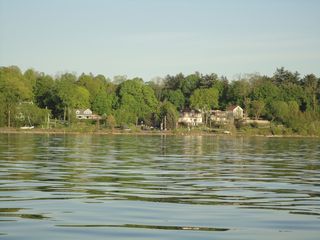
A reach is a stretch of navigable river, often the distance the eye can scan. On the Hudson there are a range of reaches, most with direct names like the Barrytown Reach or the North Germantown Reach. Some have names that have existed since when Henry Hudson sailed up the river in 1609 like the Long Reach off of Poughkeepsie. When Ed Abbey claims the desert in Desert Solitaire as his own, “Abbey Land,” it is because he is the only one there and because he loves it. I too make my claim out of love, but I can’t claim I am the only one on the river. I share my reach with many—many who no doubt imagine that this is their reach as well.
Spring Cleaning

Lucky for me, the town of Red Hook holds an annual clean up day. On Saturday, fifty people took to the local roads with gloves and large black plastic bags to collect bottles and whatever else people enjoy tossing by the side of the road. Through the winter, all of this debris is hidden. When the snow melts, all of our carelessness is revealed.
My road to clean was Sengstack Lane, at the north end of my home in the village Tivoli. I cleaned this section of road last year and ended up with two tires and six bags of junk. This year, I only needed but two bags. Is it possible that less litter was left behind? Or was it simply that last year’s effort took in several years of debris? (This clean up has been in place since 2009 so this is possible.)
Sengstack is part of my morning walk. When I reach this stretch of road, the sky opens up with a large, empty horse farm to the north and the Catskills on the western horizon. A harrier often works the field, and I watch him as he cruises just above the tall grass line scanning for prey. On this day I was serenaded by a flicker’s call, a field sparrow in the phragmites patch, and an insistent cardinal. I wore a wide-brimmed hat in the afternoon sun, and carried my garbage pick up stick to reach into the bushes, grab bottles and cans.
Picking up garbage can be a social event, or when alone, deeply meditative. It was quiet along the road; a few cyclist out for a ride in the warm spring air waved as they passed. Other than that it was me, my bag of garbage (that started to stink), and the wide sky. I thought of nothing and everything. I solved no world problems or personal problems. I just enjoyed the small but real satisfaction of making these few miles of road tidy.