Baby Beaver
 Horned GrebeI am an optimist. But on Tuesday morning as I launched my kayak onto the Hudson River at 7:30 in the morning I was not filled with my usual sense that just around the corner was the next glorious sight. I wouldn't say I was feeling pessimistic, but rather more grumpy. And I was grumpy because the height of migration has passed--it comes and goes so quickly it is excruciating. I decided that nothing special could come my way ("all the best birds are gone" I said to a friend, sounding like a twelve year old having a tantrum). Armed with this bad attitude, I stroked south under a bluing sky toward Magdalen Island and the entrance to the North Tivoli Bay.
Snapping Turtle Rescue
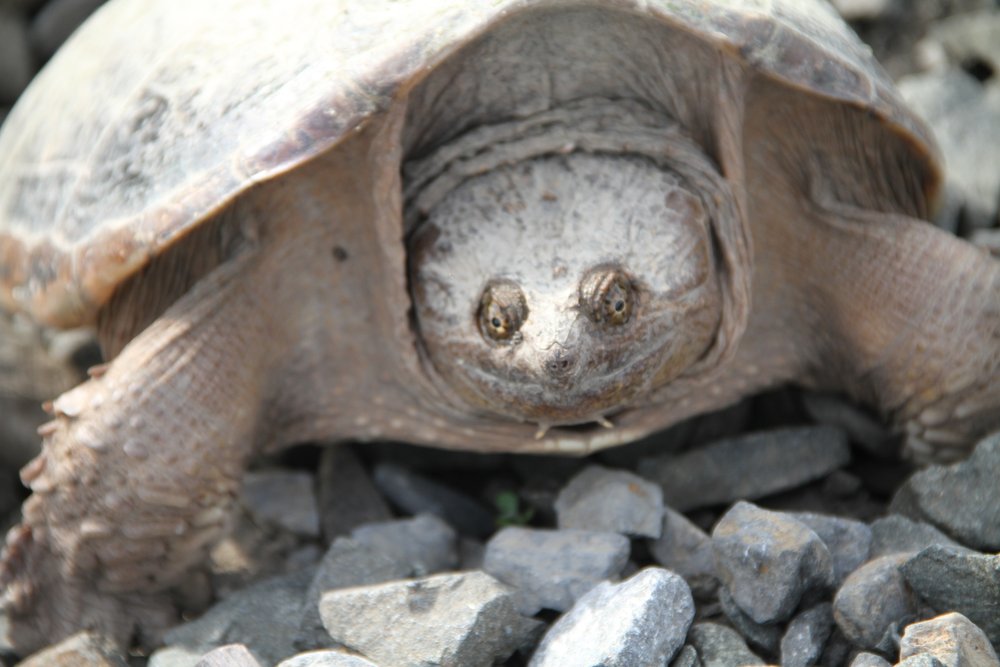 The snapping turtle rested between the rails of the north bound Amtrak line that rims the Hudson River. If she stayed there, she would be fine, that is, a train would simply sail over her. It must have taken some determination for her to get over the railing—that is the biological willpower of a snapper who wants to lay eggs. But she now looked weary, as if she might not have the resources to get back out. If she loitered on the rails—she’d end up squashed. Another turtle just twenty feet away, lay with its shell caved in, head severed.
Perfect Timing
 Garbage CrewIt takes a while before we start to see the garbage. A bottle here or there rests at the edges of the still-brown cattails and phragmites that line the waterway that meanders through the North Tivoli Bay. When I pull the canoe up onto the mucky embankment Susan Lyne gets out and from her standing perspective locates a half dozen more items that don’t belong, items made of plastic or Styrofoam,glass, metal. She scoops them up, along with a plastic turkey, and we jam everything into two bags, one in front of her son, Emmet, the other behind him. Emmet is our youngest garbage collector and while he showed a real talent on land, grabbing things with the garbage picker, he’s less excited about being in the canoe. “It’s dirty,” he explains.
Beautiful, Until it is Not
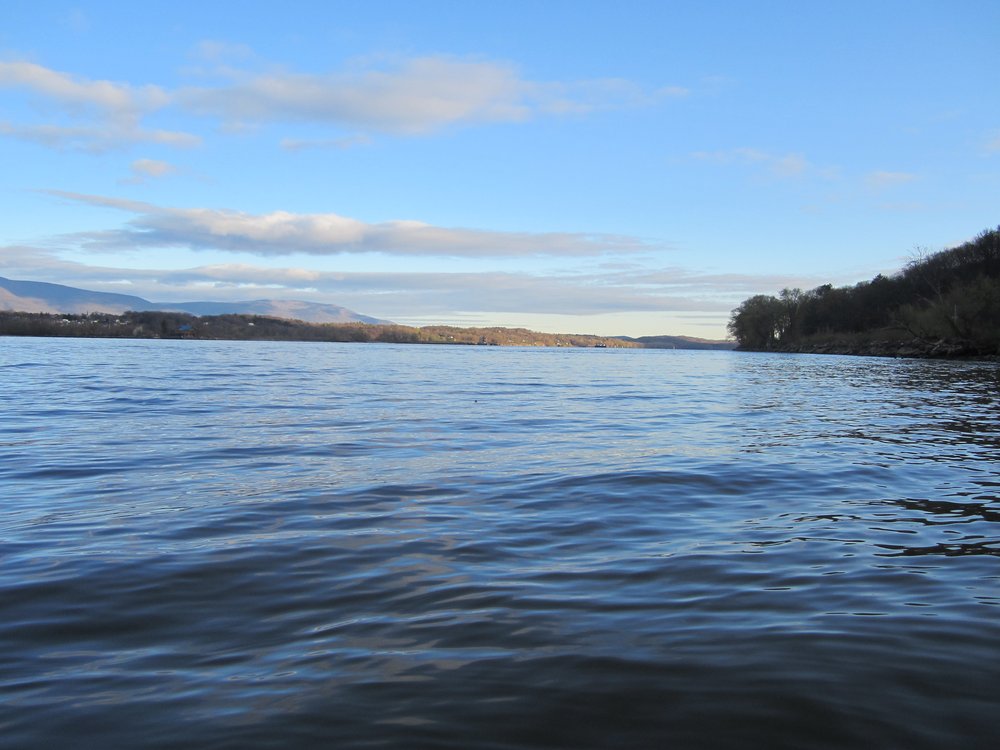 looking north; the barge is on the horizon!When I talk about kayaking on the Hudson I am always sure to add a cautionary note: look out for the big boats. Tankers, barges pushed by tugs, and container ships all ply the waters of the Hudson. The river is theirs, and it’s important to stay out of the way: boats can’t brake or swerve. They need to stick in the limited shipping channel. I have heard that the captains of these big boats refer to kayakers as speed bumps; most of the time they don’t see us at all.
It would seem that staying out of the way of a big boat would be easy. They take up a lot of room; they are visible. But it is not that simple. This morning as I slipped my boat into the water at the Tivoli landing, the water was lightly feathered. At 41 degrees, I urged the sun and its promised warmth as it peaked over the eastern shoreline. A faint rumble emerged from the north. I scanned the river and saw nothing. But the noise wasn’t going away. It had to be a boat. I looked more closely. There, on the horizon, was a double barge, pushed by a tug. It was enormous. And it was almost invisible, thanks to my angle, the angle of the sun, the height of the barge. It all worked against me. I hugged the shore until it chugged past, then I made a dash for the western shore.