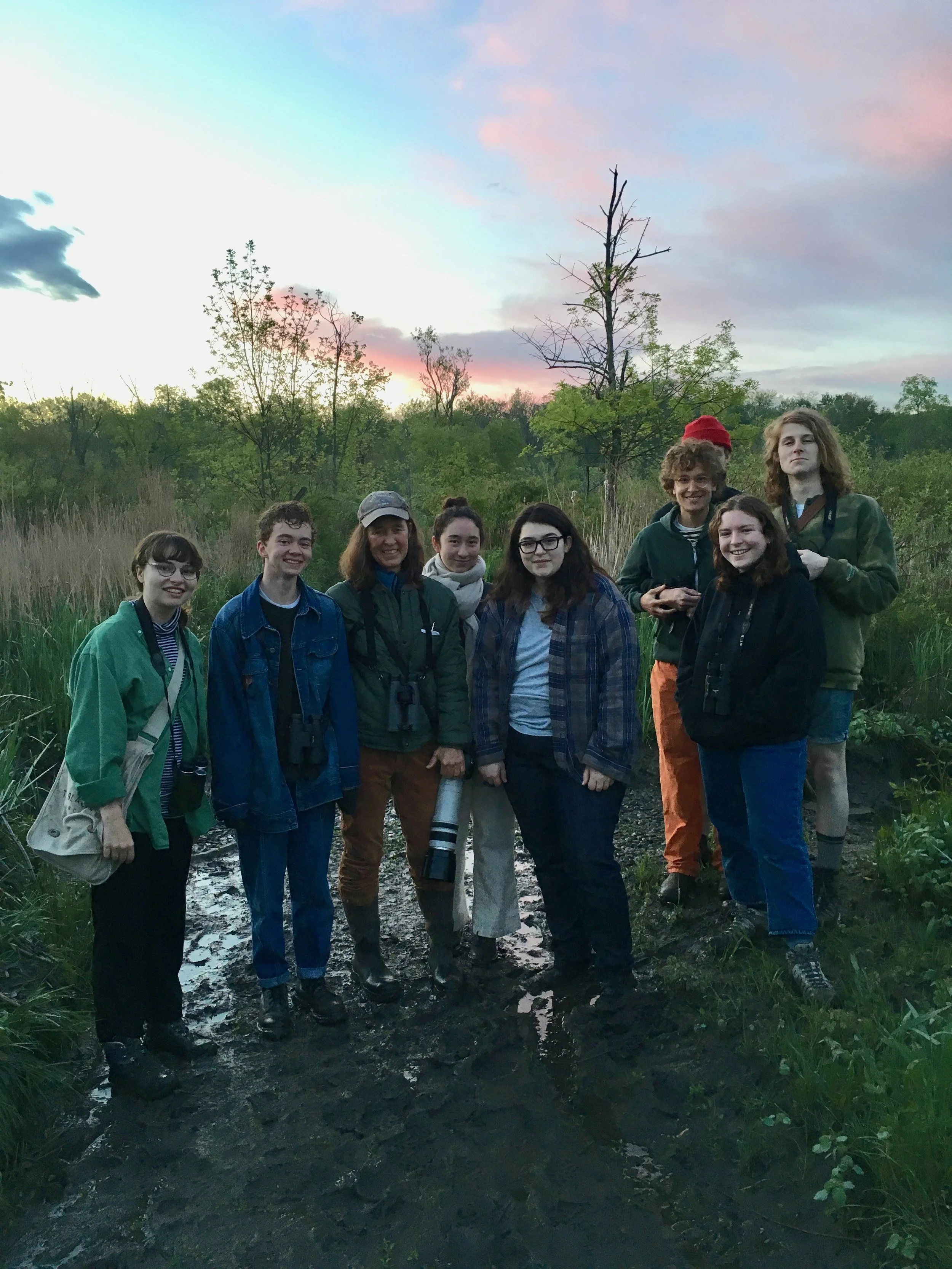
On December 18, I rose at 2:45 in the morning, and in perfect silence and darkness drove out to Ulster County, intent on starting Christmas Bird Count with the secretive birds, the owls. They were holding out on us—that is, not hooting--as Peter and I drove to perfect owl locations, listened and whistled. Eventually we heard a few Screech Owls, but we never heard a single toot from a Saw-whet (an owl that has been reliable on our count). Peter and I both felt this was a bad omen, surely a lousy count was going to unfold in daylight hours. Plus, we had dreadful weather. As our sector leader, Steve Chorvas put it: “Environmental conditions can best be described as wet and dreary with low visibility.” Indeed!
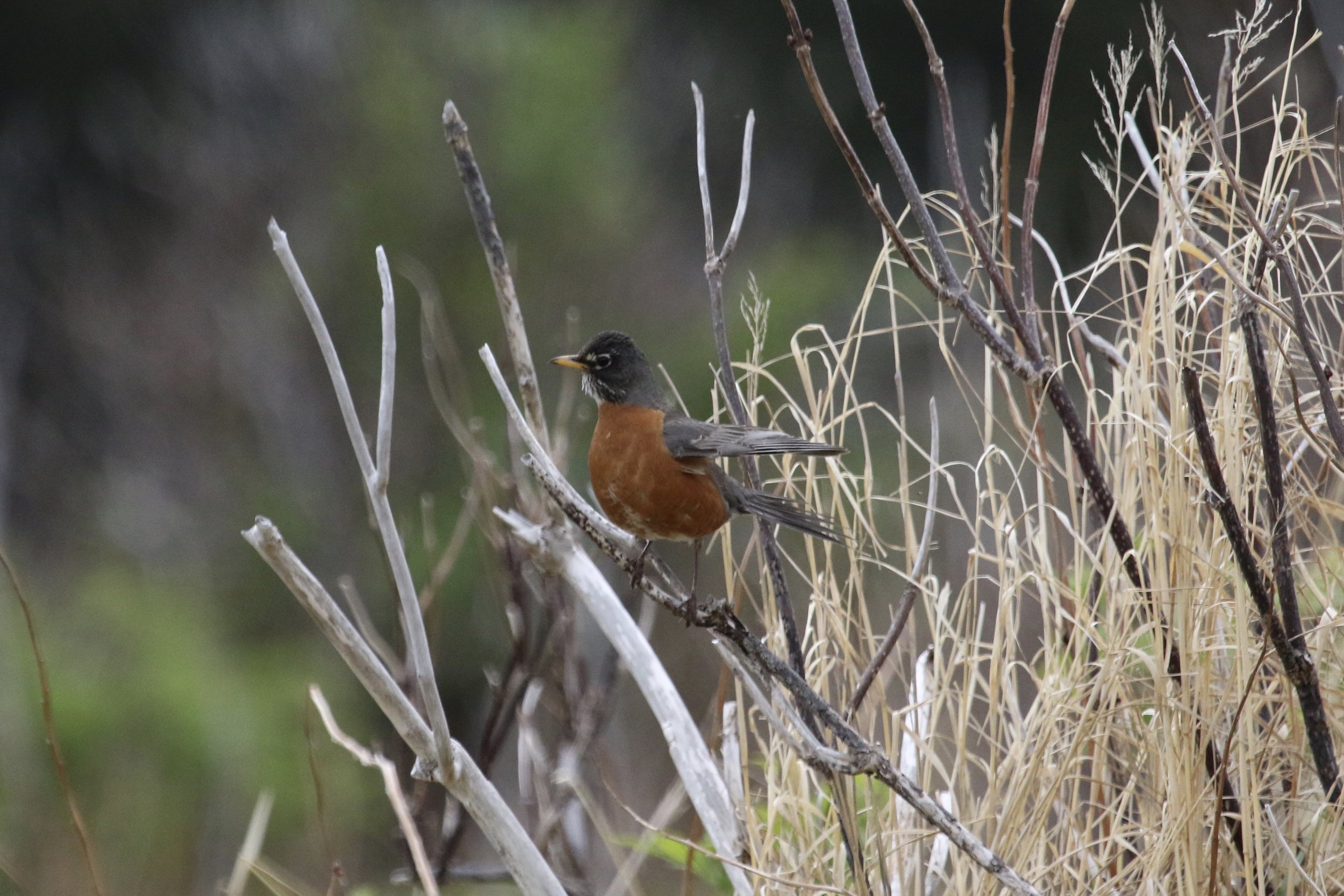
But we were wrong. There were birds. On this 2021 Christmas Bird Count—my eleventh in this sector, marking my years as a devoted birder—in Ulster County, New York, what we saw and counted were American Robins. Thousands. At every stop to look and listen and count we heard the song of the Robin, giving our rainy day the sound and feel of early spring, not early winter. They darted near the winterberry, they hopped through tangles of multi flora rose, they speckled small lawns. There were 416 of them. The only bird we saw more of were European Starlings, at 418. Together these two species made up half of the birds that Peter and I saw on that long day of counting birds.

Finding a Robin nest is fun, but not hard.
Did we get up imagining that we would see Robins? Did we hope for Robins? No, and no. We knew we would see some Robins—we always do (though more like 25). But beyond that, we never know what we will see, which is part of the magic of Christmas Bird Count. We become footloose ornithologists as we try and explain why we heard no Saw whet Owls, or what the Great Horned Owls were doing at 3 a.m. besides talking to us. We scan and listen and Peter always tells me I won’t hear anything with my window up, the cold air blowing through the car. I roll the window down to hear a Blue Jay, a Crow, adding them dutifully to the list of birds seen. And always, we hope for something special. But on this day what is special is not a species but the volume of an utterly ordinary species.
I want this number of birds to be just a “wow, so many birds” cool event. But, it’s hard for that puzzling not to take a dark turn. Our winter has hardly been cold. (Where is the snow? Please snow!) If the ground is still soft, if there’s open water—there’s plenty for the Robin to live off of. Why migrate if you can stay put and stay fat? But is the reason it is so warm another sign of climate change or is it…just a warm winter? Since I do not have the answers to these questions and I do not want this to be a dark post—I want a joyous one to bring in 2022—I will, instead, just think about all of the Robins.
Edwin Howe Forbush, who wrote the wonderful, three volume Birds of Massachusetts and other New England States (published in the late 1920s) begins his entry on the American Robin by celebrating that the bird sings every morning, all across the continent. The Robin is everywhere and everyone knows him. So he asks: “Why then should one write about his haunts and habits, which should be well known to everybody? In answer to this it may be said in truth that most people really know very little about him.”
It is in “Haunts and habits” that is the charm of these guides. Forbush combines his experience and observation of the bird with those of people around New England who write in with what they’ve seen—mostly quirky experiences with a bird. And together they start to form a portrait of the bird, a way to know what it eats, where it nests, what its relationship is to humans.
It is true that a creature too familiar often gets less real attention. We dig into the lives of those who are more mysterious (with people as well!). Like a worn couch or comfy chair, the Robin just is there. It is the one bird that all children know, not just because the bird is present everywhere but, more importantly, easy to see as it hops on a lawn or makes a nest in a nearby bush. Forbush observes that it is often very social with humans, and has stories of Robins that follow farmers in their fields. What is it that Forbush thinks we don’t know?

European Robin—not really an American Robin, except for the red breast
We don’t know that it’s really not a Robin—that is the European bird, and Britain’s national bird. Our Robin reminded early ornithologists of the bird they knew from home so they assigned it the same name, with American attached (here I will not make a detour into protesting the names of birds). He goes on for six long pages about the Robin, as if it were an unknown species, giving information on its less-than monogamous ways (even though the bird is seen as a model of constancy) and that it often does spend the winter in New England (though most migrate south, often to Texas or Florida). And what I really did not know is the brutal way that these birds were killed (at night, while roosting, their heads snapped off)--then sold for sixty cents a dozen to be eaten (do not tell me Robin tastes like chicken!). Though our bird populations are plummeting, at lease the decline is no longer from this sort of slaughter, where in one night a person could kill 400.
And here is what I want to know that Forbush doesn’t tell me: What is a group of Robins called? One piece I read said, a rash, a hood, a riot. Another says, a round of Robins, and a final one, a worm of Robins. Whatever the name, a lot of Robins--5,949 total in our count circle (which surpasses the high of 3,504 seen in 2017)--is a wonderful sight. Here’s to Robins and all of the birds in 2022 and beyond!

Mama Robin bringing food to her young